
中科大地球与行星物理学术报告通知(202607期)- Maleen Wijeratna Kidiwela
报告人:Maleen Wijeratna Kidiwela(University of Washington华盛顿大学)
报告题目:From Seafloor Observatories to Urban Fibers: Monitoring Strain, Fluids, and Seismicity with Ambient-Noise Interferometry, Seafloor Geodesy, and Edge-Based DAS
报告时间:2026年4月21日(周二) 9:00-10:00
报告地点:线上腾讯会议:187-673-369
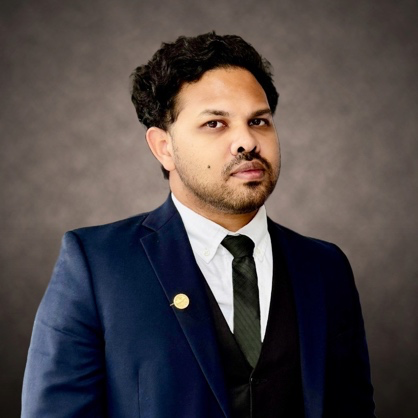
报告人简介:
Maleen Wijeratna Kidiwela is a recent PhD graduate in marine geophysics at the University of Washington. He earned his BS in Professional Geology from Mississippi State University in 2019, and his MS and PhD in Oceanography from the University of Washington in 2023 and 2026, under the supervision of William Wilcock. His primary research areascjournals such as Science Advances, Geochemistry, Geophysics, Geosystems, and Marine Geology. He received the AGU Outstanding Student Presentation Award in 2024 and co-organizes the annual Seismology Student Workshop.
报告内容摘要:
Submarine plate boundaries accommodate strain and fluid transport through processes that are difficult to observe, because satellite geodesy cannot reach the seafloor and sustained in-situ measurements remain sparse. My PhD research addressed this gap at three contrasting tectonic settings using ambient noise interferometry, horizontal seafloor geodesy, and active-source tomography. At the Cascadia subduction zone, a decade of continuous ambient-noise records from cabled observatories revealed fluid highways along the décollement and Alvin Canyon Fault that modulate rupture behavior and coincide with slow slip on near-trench protothrusts. At Orca Volcano in the Bransfield Basin, a 3D P-wave tomography experiment imaged an asymmetric back-arc rift in which a Phoenix-slab tear hydrates the mantle and drives distributed northeastern extension rather than focused spreading. At Axial Seamount, three years of horizontal acoustic ranging complementing the 25-year pressure-geodesy record showed that caldera deformation is accommodated primarily by volumetric inflation of dual magmatic sources rather than by slip on buried ring faults, with a roughly 12-month lag between eastern and western caldera extension. Building on these observational results, my future work develops EdgeDAS, a portable edge computing framework that transforms continuous distributed acoustic sensing streams into real-time event catalogs, ranked anomaly streams, and ambient-noise interferometric products with quantified uncertainty. The architecture targets a central bottleneck of modern DAS deployments, the mismatch between data volume and cloud-based processing, and is designed to run equivalently beneath the Hefei metro lines, along the Tanlu fault, and across USTC's offshore arrays, supporting earthquake monitoring, fault detection, and hydrologically sensitive near-surface observation.
 返回列表
返回列表
 地址:
地址: 电话:
电话: 邮箱:
邮箱: